
This is a guest blog from Community’s National NEC Member for LGBT+, Paul Thomas, written following a training session with the TUC about tackling sexual harassment in the workplace.
Today we attended training focused on one of the most important equality and workplace safety issues facing workers and trade unions: preventing sexual harassment at work.
The day brought together research, employment law and practical workplace approaches, with contributions from the Workers Policy Project, researchers Dr Ruth Beresford and Dr Bob Jeffery, and employment law specialists from Morrish Solicitors.
Around 85 people attended, and one message came through particularly strongly: we need to move beyond responding to sexual harassment after it has happened and start treating prevention as a core workplace responsibility.
Sexual harassment is sometimes treated as an issue of inappropriate individual behaviour. Today’s training challenged us to look much deeper. At its heart, sexual harassment is often about power.
That power can come from management hierarchy, seniority, job insecurity, control over shifts or opportunities, customer relationships, workplace culture or simply working in an environment where certain behaviour has become accepted as normal.
The research presented to us demonstrated just how significant the issue remains. Sexual harassment is overwhelmingly gendered, with women considerably more likely to experience it, while LGBT+ workers, younger workers, racialised workers and those in insecure employment can face additional vulnerabilities.
One of the questions put to us was particularly important: How prevalent is sexual harassment in our workplaces given not every instance of harassment is reported.
Why don’t people report?
Research presented by Dr Ruth Beresford and Dr Bob Jeffery explored the barriers workers face when talking about and reporting sexual harassment.
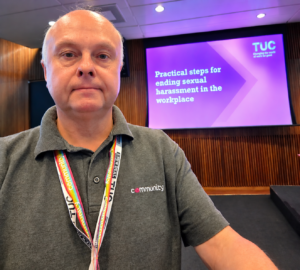
Paul Thomas at the TUC’s training session – ‘Practical steps for ending sexual harassment in the workplace’.
Sometimes people simply do not immediately recognise what has happened to them.
There can also be a perceived hierarchy of harassment, then there is normalisation. Comments become “banter”. Behaviour becomes “just what happens here”. Somebody becomes known as the workplace “creep” without anyone challenging why their behaviour continues to be tolerated.
Fear is another major barrier. Workers may worry about their job, their hours, their career or how colleagues will treat them afterwards.
And sometimes the reporting mechanism itself creates a barrier. A policy might technically exist, but what happens if you can only access it through a manager, and the manager is the person you need to complain about?
This is an area where trade union and equality reps can make a genuine difference. Sometimes the first person to recognise what a member is describing as potential sexual harassment may be their union representative.
Sexual harassment is a health and safety issue
For me, one of the most significant parts of today’s training was the Workers Policy Project’s approach to sexual harassment as a workplace hazard.
We routinely assess workplace hazards, identify who could be affected, introduce controls and review whether those controls work. Sexual harassment should be approached with that same preventative mindset.
That means considering risks associated with lone working, night working, isolated workplaces, customer-facing roles, workplace travel, third parties, insecure employment, workplace hierarchies and cultures where sexualised comments or inappropriate “banter” have become normalised.
It also means recognising that different risks can overlap.
This presents an important opportunity for equality reps and health and safety reps to work together.
The law is moving further towards prevention and the legal session delivered by Morrish Solicitors reinforced the importance of this preventative approach.
Employers already have a positive duty to take reasonable steps to prevent sexual harassment and from 30 October 2026, the Employment Rights Act 2025 will strengthen this further towards a requirement to take “all reasonable steps”. That creates an important question for employers.
It will no longer be enough simply to point towards a policy and say, “We have something in place.”
The question becomes: What did you actually do to prevent this happening — and what else could you reasonably have done?
The EHRC’s eight-step guide to preventing sexual harassment at work provides a useful framework: develop an effective policy; engage workers; assess and reduce risks; provide effective reporting routes; train workers and managers; respond properly to complaints; address third-party harassment; and monitor whether the measures actually work.
A bigger role for equality reps
For trade unions and equality reps, today’s training should be the beginning rather than the end of the conversation.
We should be going back into our workplaces and asking some more challenging questions, such as “does our employer actually have a sexual harassment risk assessment?” and “who was consulted when it was produced?”.
As the role of equality representatives develops, we should not see equality reps simply as people who become involved after discrimination has occurred.
There is an opportunity for equality reps to become part of the preventative infrastructure of the workplace — identifying risks, listening to workers, spotting patterns, challenging workplace cultures, scrutinising policies and working alongside health and safety representatives and employers to prevent harm.
That is where we can deliver real change. Today’s training wasn’t simply about understanding what sexual harassment is. It was about changing the question. Instead of asking: “Has anybody reported sexual harassment?” we should be asking:
“Where could sexual harassment happen in our workplace, who could be at risk, what are we doing to prevent it and how do we know those measures are working?”
That is the conversation I believe trade unions, equality reps and employers need to have next.

© Community Trade Union 2026




Thank you. We have received your query
We have received your query and a member of our Service Centre Department will be in touch to discuss further with you.
Due to service demands it is not always possible for our advisors to reply to your query immediately. We aim to respond within 48 hours of receipt.
If your employer has invited you to a formal meeting (disciplinary, grievance or appeal) and you are seeking representation, if you have not already done so via this form, please provide us with all relevant supporting information including any notes/minutes from any investigation process and your email/letter of invitation, which should include full details of when and where the meeting is due to take place.
Please note that representation is not provided for investigation meetings.
If you have any further queries, please contact our Service Centre Department on 0800 389 6332 or at servicecentre@community-tu.org.
Not a member?
Let’s get to know each other.
"*" indicates required fields